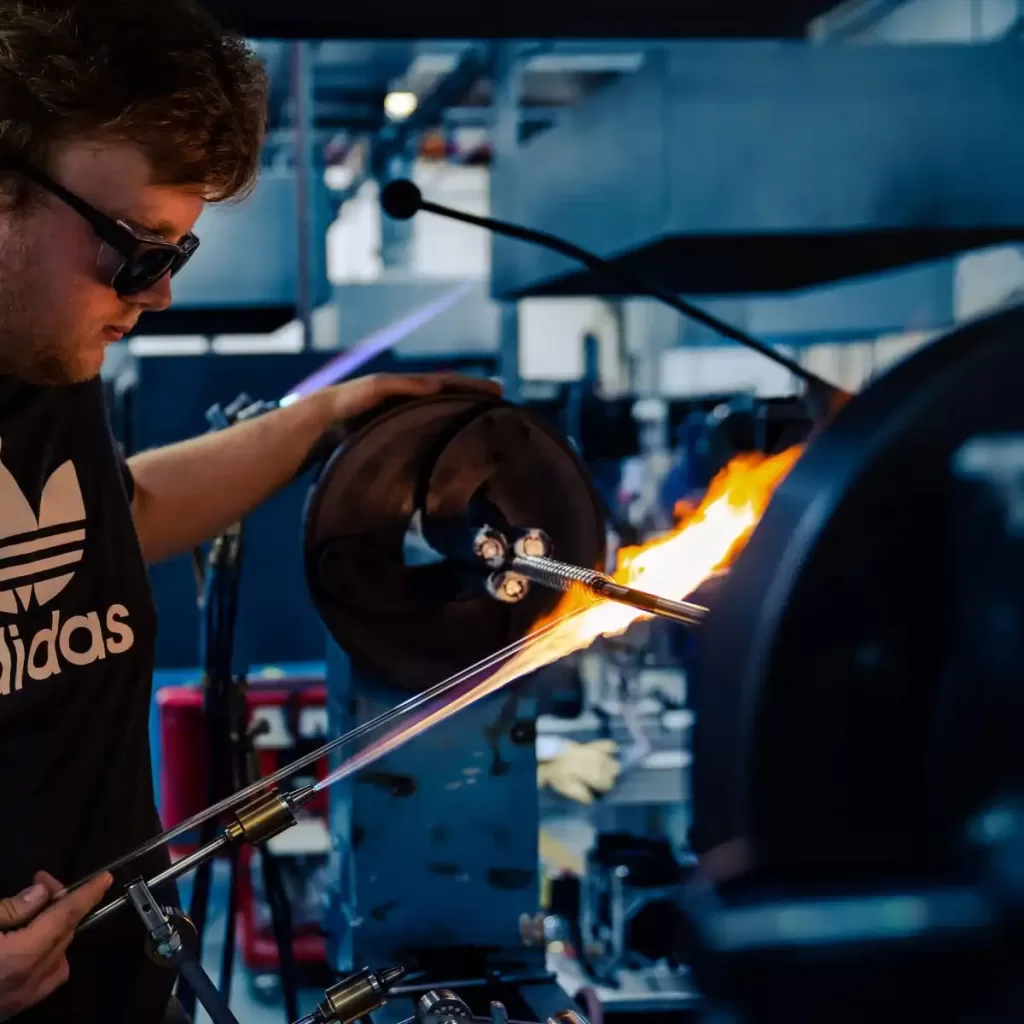
High-Performance Glass Bioreactor Vessels for Cell Culture
When process development requires absolute precision, reliability, and the ability to seamlessly scale up from benchtop to production, glass bioreactor vessels remain the gold standard. At Cambridge Glassblowing, we engineer and manufacture custom glass bioreactor vessels that combine the superior chemical inertness of borosilicate glass with innovative, user-centric design. Our vessels are trusted by bioprocess engineers and cell culture scientists across the pharmaceutical, biotechnology, and food & beverage sectors for their exceptional performance, guaranteed quality, and unmatched compatibility with existing control systems.
We specialize in multi-use glass bioreactor vessels designed for optimal cell culture performance, focusing on critical factors like oxygen transfer, mixing efficiency, and aseptic control. Whether you are optimizing a mammalian cell culture or scaling up a microbial fermentation, our expertise ensures your vessel is built to meet the most demanding specifications and regulatory compliance requirements.
What is a glass bioreactor vessel?
A glass bioreactor vessel, often referred to as a fermenter or stirred tank reactor (STR), is a sterile environment designed for the cultivation of living organisms, such as mammalian cells, yeast, or bacteria. Its key components typically include the vessel itself, constructed from superior borosilicate glass, a metal headplate that seals the system, various impellers and spargers for mixing and aeration, and ports for sensors (DO, pH, antifoam) and feeding lines. The primary advantage of using glass is its inertness, which prevents unwanted reactions with the culture medium, its transparency for visual monitoring, and its inherent autoclavability, allowing for reliable and validated sterilization cycles. Our glass vessels can be constructed at different sizes, depending on whether you require benchtop bioreactors, or a larger pilot-scale solution.
Key features and benefits of our glass bioreactor vessels
Our design philosophy centers on maximizing process performance and operational ease, distinguishing our glass bioreactor vessels from standard commercial offerings.
Superior material quality and design
We exclusively use high-quality borosilicate glass (3.3) for the vessel body, ensuring maximum chemical resistance and thermal stability through repeated sterilization cycles. Our innovative vessel geometry and baffle design promote optimal mixing and liquid flow dynamics. This results in reduced shear stress—a critical consideration for sensitive mammalian cell culture—while simultaneously ensuring efficient mixing for high-density microbial culture applications. Our vessels are designed to be robust and reliable for multi-use applications, reducing long-term operational costs compared to single use bioreactors.
Precise control and monitoring
The ability to maintain consistent and optimal growth conditions is paramount. Our vessels are engineered with precise temperature control capabilities, utilizing double-jacketed designs for superior heat transfer efficiency. The use of magnetic drives ensures hermetic sealing, preventing contamination while allowing high-performance stirring. Our precision glassware is built to integrate seamlessly with standard process control sensors, supporting accurate monitoring of dissolved oxygen (DO), pH, and other critical process parameters.
Applications of glass bioreactor vessels
The versatility of glass bioreactor vessels makes them indispensable across the bioprocessing lifecycle, from early-stage research to regulated manufacturing environments.
- Mammalian cell culture: Ideal for cultivating delicate cell lines used in the production of monoclonal antibodies and therapeutic proteins, where low shear stress and precise control are essential.
- Microbial fermentation: Suitable for the high-yield production of proteins, enzymes, and compounds, allowing for high oxygen transfer rates (OTR) necessary for aerobic processes.
- Stem cell bioprocessing: Provides the tight control and sterile conditions necessary for propagating and differentiating stem cells in regenerative medicine research.
- Process Development and Optimization: Allows for rapid iteration and testing of control strategies, media formulations, and operating parameters before scaling up.
- Good Manufacturing Process (GMP): Our compliance-focused manufacturing processes provide the necessary traceability and quality assurance for use in GMP environments.
Glass vs. single-use bioreactors: cost and performance analysis
When considering investment, bioprocess professionals must weigh the upfront capital expenditure of glass bioreactor vessels against the recurring operational expenses of single-use bioreactors.
Cost and environmental impact
While glass systems have a higher initial capital cost, their long-term operational costs are significantly lower. Single-use systems incur high recurring expenses for disposable bags, sensors, and associated waste disposal—a major environmental consideration. Glass bioreactor vessels are designed for repeated use over many years, requiring only sterilization and cleaning (SIP/CIP), providing a substantial return on investment (ROI) and minimizing environmental waste. We can assist with a detailed cost breakdown comparing upfront costs, operational expenses, and long-term maintenance.
Performance and process considerations
Performance is often measured by the oxygen transfer coefficient (kLa), which measures the efficiency of oxygen transfer into the culture medium. Our glass vessels are optimized for high kLa figures in microbial culture and low shear environments for cell culture.
| Feature | Glass bioreactor vessel | Single-use bioreactor (sub) |
| Material | Borosilicate glass (3.3) | Plastic films (PE, PET) |
| Sterilization | Autoclavable / SIP/CIP-ready | Gamma irradiation (pre-sterilized) |
| Long-term cost | Low (high upfront) | High (recurring disposables) |
| Customization | Excellent (headplate, volume, impeller, etc…) | Limited (standardized bags) |
| Shear stress | Can be tailored for low-shear | Often higher due to mixing method |
The choice often comes down to the application: glass is favored for long-term production, high kLa microbial applications, and processes requiring the highest degree of process control and validation.
Technical specifications and customization options
We pride ourselves on providing highly configurable glass bioreactor vessels that integrate effortlessly with your existing lab infrastructure.
Sizes, volumes, and ports
Our vessels are available in standard benchtop sizes, ranging from 1 L to 20 L working volume, and can be customized beyond that. We offer a wide range of headplate port options to ensure compatibility and process flexibility, including standard sizes like PG13.5, 19mm, 24/29, and various thread types. This allows for simple integration of all standard sensors (DO, pH, temperature, level) and gas mix lines.
Impeller and sparger designs
To ensure optimal performance for your specific cell type, we offer various impeller and sparger options:
- Impellers: Choices include Rushton turbine (high-shear, microbial), Pitched Blade (axial flow, general-purpose), and Marine Blade (low-shear, mammalian cell culture). We can advise on the ideal impeller/sparger combination to achieve target kLa and shear profiles for your application.
- Spargers: From ring spargers for general use to porous frit spargers for finely dispersed bubbles and high oxygen transfer.
Controller compatibility
Our vessels are designed to be fully compatible with major bioprocess controllers on the market, including those from Sartorius, Eppendorf, and Thermo Fisher Scientific, as well as third-party control systems like Emerson DeltaV Live. You can verify compatibility with your bioprocess controllers, probes/sensors (DO, pH, antifoam, gas mix) by providing us with your headplate pattern requirements.
Regulatory compliance and quality assurance
Compliance is non-negotiable in bioprocessing. Our commitment to quality ensures our glass bioreactor vessels meet or exceed industry standards, supporting your regulatory submission and audit processes.
Good Manufacturing Practice
Our manufacturing processes adhere to the principles of Good Manufacturing Practice (GMP), providing detailed traceability and comprehensive documentation for every component. This ensures that the equipment you receive is reliable, repeatable, and fit for use in regulated environments.
Validation and quality control
We provide support for validation services to streamline your facility qualification. All vessels undergo stringent Quality Control (QC) procedures, verifying dimensional accuracy, joint types, and material composition. Crucially, our vessels are designed to withstand validated sterilization cycles (autoclave or SIP/CIP) for multi-use, ensuring process integrity.
Request a quote or product demonstration
Ready to elevate your microbial culture and bioprocessing capabilities with custom, high-performance glass bioreactor vessels?
We understand that bioprocess needs are unique. Contact our sales team today to request a quote or schedule a product demonstration tailored to your specific application. Whatever your requirement, we can design a solution for you, from compact benchtop bioreactors to larger floor standing pilot-scale units. Our lead times are highly competitive for custom builds, and we provide comprehensive after-sales support, including installation assistance, and spare parts.
Request a quote for your custom glass bioreactor vessel.
- Explore our full range of scientific laboratory glassware and learn about our capabilities as a leading scientific laboratory glassware manufacturer.
- See our full list of custom services.